Product-specific tax calculations
Zonos supports product-specific U.S. sales tax calculations for increased accuracy across different product categories. While general sales tax rates vary by location, certain products—such as clothing, food items, and books—may have different tax rates or exemptions depending on state and local laws.
Our product-specific tax system automatically applies the correct rate based on both the destination and the type of product being sold. For example, clothing might be tax-exempt in one state but taxed in another, while books may have reduced rates in certain jurisdictions.
How it works
Zonos leverages harmonized system (HS) codes—already used for international shipments—to determine the appropriate product-specific tax rate. This means no additional product categorization is required on your end. Our system automatically:
- Leverages existing HS code data to identify the U.S. product category (if not available, Zonos will Classify on the fly)
- Applies the correct state, county, and local tax rates for that specific product type
- Handles exemptions and special rates for categories like clothing, books, food items, and digital services
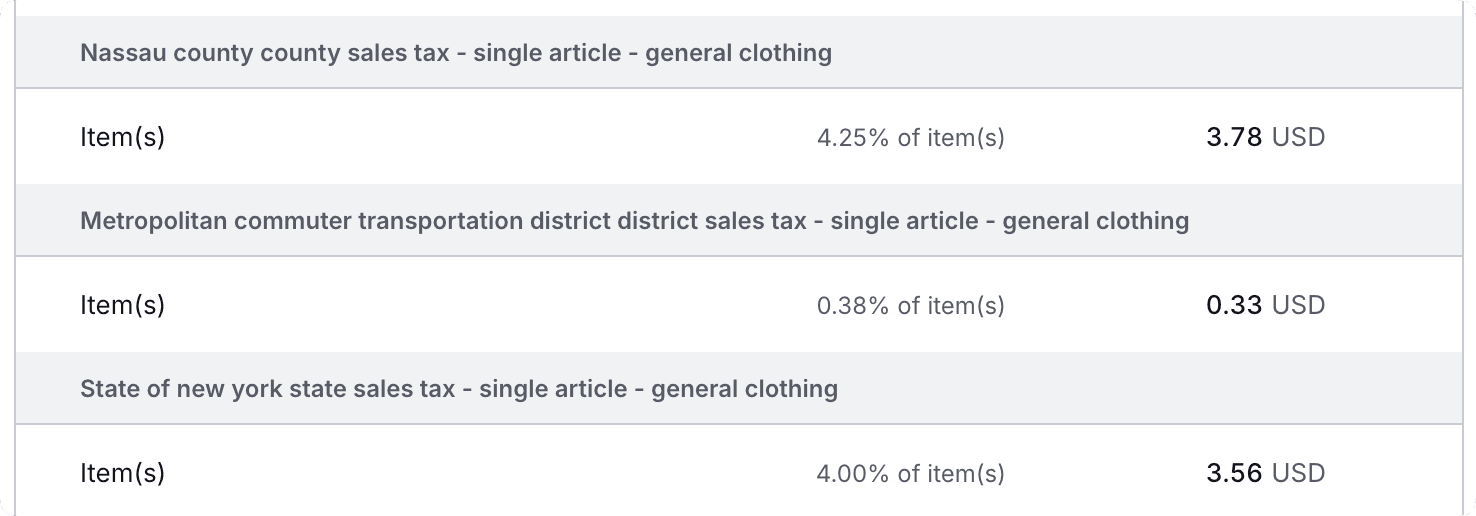
This enhanced accuracy helps ensure compliance while providing your customers with precise U.S. sales tax calculations. You can view a detailed breakdown of the applicable tax rates for each state, county, district, and city in the landed cost breakdown on the order details page.
Here's an example where state and county taxes are applied:
Clothing and footwear exemptions
Many U.S. states exempt clothing and footwear from sales tax, either fully or up to a per-item price limit. Zonos applies these exemptions automatically based on each item's HS code, price, and destination—no additional setup is required. Because Zonos evaluates every item individually, a single order can contain both taxable and exempt items.
These exemptions generally fall into two categories:
- Blanket exemptions (no price limit): Most clothing and footwear is exempt regardless of price. States in this group include Minnesota, New Jersey, Pennsylvania, and Vermont.
- Per-item price thresholds: Clothing and footwear is exempt only when an individual item's price falls at or below the state's limit. For example:
- Massachusetts — items priced $175 or less
- New York — items priced under $110
- Rhode Island — items priced $250 or less
When an individual item's price is above the state's threshold, that item is taxed according to the state's rules. Some localities in additional states—such as Alaska, North Dakota, and Tennessee—apply their own clothing tax rules, which Zonos also honors at the jurisdiction level.
Zonos U.S. sales tax solution models
Zonos offers two primary models for handling U.S. sales tax compliance, depending on your integration and business needs: our co-operator model and our merchant of record model.
API, Shopify, or marketplace: Co-operator model
For merchants using our API, Shopify, or marketplace integrations, Zonos functions as a co-operator. With this model, the merchant handles their own payment processing and Zonos doesn't appear on bank statements, but the tax compliance aspects are still fully managed by Zonos.
Co-operator requirements
For Zonos to provide co-operator services for U.S. sales tax, the following must be in place:
- Zonos Hello integration — Zonos Hello must be implemented on your website (even if running invisibly in the background without the flag icon).
- Landed cost calculation — Zonos must be calculating the landed costs.
- Website reference — The merchant must make reference to Zonos on their website.
Zonos Checkout: Merchant of record (MoR) model
When Zonos acts as the merchant of record through Checkout for domestic transactions, we take on full legal responsibility for managing every aspect of sales tax compliance. With the MoR model, Zonos appears on the customer's bank statement as "Zonos-[merchant]", handles payment processing, and the tax compliance aspects are still fully managed by Zonos.
Phasing out existing U.S. state tax IDs
Zonos takes full responsibility for U.S. sales tax when acting as the merchant of record (MoR). For Zonos Checkout domestic orders, we automatically handle tax calculation, remittance, and filing. For other integrations, such as Shopify and API integrations, Zonos as MoR tax services are available as an opt-in. Depending on your integration, this transition means you may no longer need your own U.S. tax IDs for transactions processed through Zonos.
Selling on multiple channels
If Zonos is your only sales channel, you no longer need to maintain your own U.S. tax IDs. However, if you sell through other channels, you will still need to manage, remit, and file taxes for those transactions separately using your own tax IDs. Zonos assumes responsibility only for transactions processed through Zonos.
For detailed guidance on phasing out your existing tax IDs and transitioning to Zonos tax IDs, please refer to our tax phase-out documentation.
How do I get started with Zonos as the merchant of record?
MoR enablement requires manual setup and cannot be self-configured. To get started, contact Zonos Sales or Support to enable the MoR model for your account.
Does Zonos apply state-specific tax thresholds and exemptions?
Yes. Many states exempt clothing and footwear from sales tax—some with no price limit (such as Minnesota, New Jersey, Pennsylvania, and Vermont) and others only up to a per-item threshold (such as Massachusetts at $175, New York under $110, and Rhode Island at $250). Zonos applies these exemptions automatically based on each item's HS code, price, and destination, so customers are not charged tax on items that qualify. See the "Clothing and footwear exemptions" section above for more detail.
Are there U.S. states where Zonos doesn't collect sales tax?
Five states have no statewide sales tax—Alaska, Delaware, Montana, New Hampshire, and Oregon—so Zonos does not collect state sales tax on orders shipped to them. Note that Alaska is an exception at the local level: while it has no statewide sales tax, individual boroughs and cities may impose their own local sales tax, which Zonos still calculates and collects where it applies.
Can Zonos calculate U.S. sales tax on a platform or service fee?
Zonos calculates product-specific U.S. sales tax through our sales tax partner. Currently, Zonos does not support calculating U.S. sales tax specifically on standalone service or platform fees. If a service fee needs to be included in the taxable base, the most practical approach is to include it in the product price. When the underlying product is taxable, the fee will be taxed at the product's applicable rate; when the product is exempt, the fee will be exempt as well.
Are Zonos fees subject to U.S. sales tax?
No. Zonos transaction and service fees are a B2B charge between Zonos and the merchant for use of our platform. They are not part of the customs value of the goods crossing the border and are not included in landed cost or U.S. sales tax calculations.
U.S. sales tax
Stay compliant with U.S. sales tax—let Zonos handle it for you.
Zonos simplifies U.S. sales tax compliance with comprehensive solutions for domestic and international merchants shipping within or to the U.S. Whether using our API, Shopify, or Checkout integrations, Zonos takes on responsibility for U.S. tax management, ensuring a seamless experience for you and your customers.
With all Zonos U.S. sales tax solutions, we leverage our in-house tax data to accurately calculate state, district, county, and city taxes based on the buyer's location.
Through these solutions, we:
This end-to-end approach minimizes errors, prevents penalties, and ensures your business stays compliant with all U.S. tax laws.